


Written by
Speed is one of the main attractions of UK company formation. Many companies are incorporated within hours, and the process is widely seen as simple and efficient. However, a noticeable proportion of company formation applications are delayed or rejected each year because key compliance and data requirements are not met at the point of submission.
Based on our experience as UK company formation agents handling large volumes of incorporations across private limited companies, LLPs, companies limited by guarantee and PLCs, most applications proceed smoothly where the information provided is accurate and consistent. Where company formation delays occur, they are usually linked to identifiable regulatory or operational triggers rather than general Companies House processing times.
Understanding these common company formation rejection causes before submitting an application can help reduce risk and improve the chances of rapid approval.
How the UK company formation process works
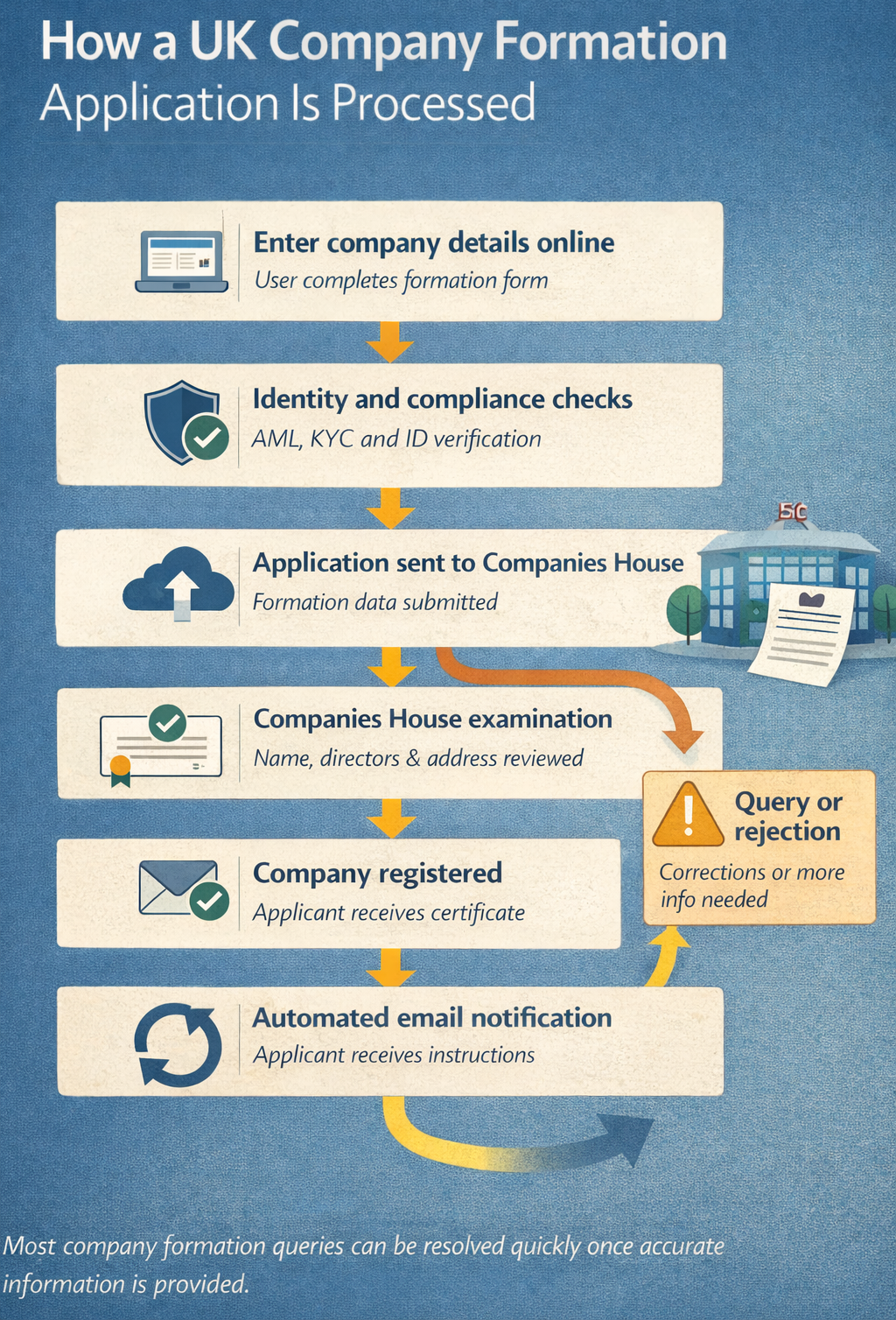
In most online company formations, the applicant enters company details directly into the formation system. Once the order is completed and compliance checks are satisfied, the company formation application is transmitted electronically to Companies House for examination. The accuracy and consistency of the information entered at the outset therefore plays a central role in whether a company is registered quickly.
Typical company formation workflow
- Applicant enters company formation details online
- Identity verification and compliance checks are completed
- Formation application is submitted electronically to Companies House
- Examiner reviews company name, director details and address information
- Application is approved or a company formation rejection query is issued
- Applicant receives an automated email notification
- Corrections are made and the company formation can be resubmitted
Why is a UK company formation delayed or rejected?
Most company formation delays arise from a small number of recurring issues. These usually relate to identity verification requirements, residential or registered office address credibility, company name acceptability and structured electronic filing validation.
Identity verification errors and personal verification code issues
Enhanced identity verification requirements mean that directors and persons with significant control must provide verified personal details before certain company formations or statutory filings can be accepted.
Common identity‑related company formation rejection causes
- Invalid or incorrectly entered personal verification code
- Identity details not matching verified Companies House records
- Director or PSC not yet identity‑verified
- Inconsistent personal data between company filings
Ensuring identity verification is completed before submitting a company formation application can significantly reduce the likelihood of delay.
For further guidance, see our detailed resources:
- Companies House identity verification guide
- VS01 verification statement guide for PSCs
Why is Companies House questioning a director’s residential address?
Company formation applications may be rejected where the residential address provided appears to be a business or correspondence address rather than a genuine place of residence.
Address‑related formation rejection triggers
- Use of virtual office or serviced office as a residential address
- Missing flat, unit or building details
- Address cannot be matched to available residential records
- Examiner requests documentary evidence of residence
Providing a complete and accurate residential address at the outset can help prevent unnecessary company formation delays.
Registered office address entitlement issues
Companies House may also reject a company formation where there is doubt that the company has the right to use the proposed registered office address.
Situations that can lead to registered office rejection
- Registered office cannot be verified or located
- Company does not appear contactable at the address
- Evidence of entitlement to use the address is requested
Ensuring the registered office can reliably receive official correspondence is essential for successful incorporation.
Can a company name be rejected after it appears available?
Yes. Company name availability search tools provide an indication only and do not guarantee acceptance by Companies House.
Common company name rejection reasons
- Proposed name is identical to an existing company
- Name is considered too similar under statutory naming rules
- Restricted or sensitive wording requires prior approval
Final approval of a company name always rests with Companies House at the point of company formation.
Structured data validation and technical filing errors
Modern company formations are processed as structured electronic submissions.
Technical reasons company formation applications are rejected
- Mandatory information fields are incomplete
- Director names entered in incorrect format
- Share capital totals do not reconcile
- Electronic schema validation errors occur
Although these issues are usually straightforward to correct, they can delay incorporation if the application must be resubmitted.
Why are confirmation statements and other filings delayed?
Similar compliance issues can affect statutory filings after company formation, particularly confirmation statements and officer updates.
Common confirmation statement rejection causes
- Identity verification not completed for all directors or members
- Personal verification codes entered incorrectly
- Invalid company authentication code
- Officer details inconsistent with verified identity records
Once corrected, most statutory filings can be resubmitted quickly.
What happens if a company formation application is rejected?
Where a company formation is rejected, the outcome is normally communicated automatically through the electronic filing platform. Applicants receive an email explaining the issue and providing access to the application so that corrections can be made.
Applicants should monitor their email inbox carefully and check junk or spam folders to ensure automated notifications are not missed. Delays in responding to rejection messages can extend overall company formation timelines.
How to avoid company formation delays
Most delays arise from avoidable issues. Applicants can improve company formation approval times by:
- Completing identity verification before submission
- Entering director and PSC details carefully and consistently
- Ensuring residential and registered office addresses are accurate
- Checking company name choices thoroughly
- Confirming share ownership information is correct
Next steps to minimise the risk of rejection
By understanding the practical causes of company formation rejection and preparing information carefully before submission, applicants can significantly improve the likelihood of rapid incorporation.
If a rejection does occur, most issues can be corrected quickly and the company formation resubmitted without restarting the process. Reviewing guidance and responding promptly to Companies House notifications will help ensure the company is formed as efficiently as possible.
Frequently asked questions about company formation delays
Why was my company formation rejected even though the name was available?
How long does it take to resubmit a rejected company formation?
Do all directors need identity verification before forming a company?
Will Companies House explain why my company formation was rejected?
Can a formation agent amend a rejected company formation application?
Written by